

Aramean DNA continuity is examined in this study through ancient DNA recovered from the Halzi Gate individuals at Nineveh, who died during the city's fall in 612 B.C. By combining genetic results with archaeological and historical evidence on the Arameans in Mesopotamia, the paper explores whether the ancient population of Nineveh reflects long-term Aramean presence and continuity in northern Mesopotamia.
Chapter 1: The Arameans in Mesopotamia — History, Kingdoms, and the Aramaization of Assyria
Origins, Early Movements, and the Aramean Capture of Nineveh
Aramean connection to Mesopotamia runs deep. A toponym A-ra-mu^ki appears as early as the third millennium B.C. at Ebla, in a geographical list that originated from Tell Abu Salabikh and was also found at Uruk. The place name is considered pre-Semitic, pre-Sumerian, and pre-Hurrian, suggesting roots older than any known language family in the region. The name Aram itself may come from a "broken" plural that originally designated herds of wild animals, such as oxen, bisons, or buffalos, that roamed the forests at the foot of Tur Abdin and the tributaries of the Middle Euphrates. The valleys of these rivers and the plain beneath Tur Abdin are therefore the most likely areas where this word, initially referring to herds, became a tribal name. The early Arameans' main deity, the Storm-god Hadad, was frequently depicted standing on a bull, reflecting this connection between the people and the wild animals of their homeland.
The first undisputed use of the name "Aramaeans" appears in the inscriptions of Tiglath-pileser I of Assyria (1114–1076 B.C.), who fought the "Aramaean Ahlamu" along the Middle Euphrates from Suhu to Carchemish. He crossed the river pursuing them, conquered six of their settlements at Mount Bisri, seventeen according to another inscription, and claimed to have crossed the Euphrates twenty-eight times, twice in one year, defeating them from Tadmar (Palmyra) all the way to Rapiqu of Babylonia. Even after blocking a major crossing point near Jebel Bishri, smaller groups continued entering Assyrian territory. The Arameans were not newcomers from a distant land. They had been present in the area between the Tigris and the Khabur rivers and in northern Mesopotamia for centuries, quietly occupying steppes and high grounds without being recorded by the literate populations of the cities.
In 1082–1081 B.C., a severe famine struck Assyria, and the situation quickly became desperate. A Middle Assyrian chronicle records that Aramean "houses," meaning clans, marched from Katmuhu on the eastern edge of Tur Abdin. They seized the roads, conquered Assyrian lands, advanced all the way to Kirruri in the Zagros mountains, and took gold, silver, and all the property of the land. The chronicle notes that "the side of the fortress of Nineveh, the country downstream" was involved. This represents the earliest known capture of Nineveh by Aramean forces, occurring centuries before the city's final fall in 612 B.C. To respond, Tiglath-pileser I had to cross the rough terrain of Kasiari (Tur Abdin), likely using the main track from the Tigris valley to Savur, then to Midyat, and onto the Sufan Cay plain in order to reach Katmuhu.
The Assyrians called the Tur Abdin mountain range Kasiari (or Kasiyari), a name also found in Hittite sources and possibly derived from Hurrian. The earliest Assyrian mention of this name comes from the inscriptions of Adad-nirari I (1300–1270 B.C.) and Shalmaneser I (1269–1241 B.C.). By the reign of Ashur-bel-kala (1073–1056 B.C.), the second successor of Tiglath-pileser I, the region was simply referred to as "the land of the Aramaeans" (KUR A-ri-me, KUR A-ri-mi, KUR A-ra-me, A-ra-ma), marking a major shift in how the Assyrians understood the land to their northwest. The "Broken Obelisk" inscription records a series of battles fought by Ashur-bel-kala in the Kasiari towns of Pa'uza, Nabula (modern Girnavaz, north of Nusaybin), Suru (modern Savur), Hulzu, and Erisu (likely Irsia, mentioned again in 882 B.C.). Looking back on this troubled era, the later king Ashur-dan II wrote that in the days of Shalmaneser II and Ashur-rabi II, Arameans had burned cities, seized Assyrian lands, and spread violence, causing many Assyrians to abandon their homes. By 971–970 B.C., even the Babylonian New Year festival, the Akitu, was not celebrated because of Aramean hostility around Babylon.
Aramean Kingdoms: Bet-Zammani, the Temanites, and Assyrian Reconquest
By the 1st millennium B.C., following the collapse of the great Late Bronze Age empires, the Arameans had become the dominant demographic force across Syria and Upper Mesopotamia. In Syria, Aramean clans had organized into recognizable states such as Aram-Damascus, Hamath, Bit-Agusi around Aleppo, and Bit-Adini on the Euphrates. Farther east, in the Jazira and the upper Tigris-Khabur zone, Aramean groups organized into named "houses," the Bit-X polities, which functioned as territorial kingdoms.
The most significant of these in Upper Mesopotamia was Bet-Zammani, named after the founding ancestor Zamman, a personal name attested among Amorites as early as the 18th century B.C. The root zamm means "to tie up," suggesting the meaning "fastener." Middle Assyrian administrative records from Tell Billa, dating to the early 13th century B.C., already mention the Bet-Za-ma-ni tribe settled north of Tur Abdin, implying that they constituted the bulk of the local population even at that early date. The capital of Bet-Zammani was Amida, modern Diyarbakir, which sits on a basaltic plateau on the right bank of the Tigris. The city is still surrounded by walls of black basalt, giving it the Turkish name Kara-Amid ("Black Amid"). It was strategically located at the head of navigation on the Tigris and near the rich copper mines of Ergani-Maden. The territory of Bet-Zammani stretched between the southern slopes of Tur Abdin, the Karaca Dag to the west, and the Arganasu river and the Tigris to the north. Neighboring Aramean states included Bet-Yahiri in the land of Izalla, and the petty kingdom of Assa, whose ruler Geri-Dadi paid tribute to Ashurnasirpal II in 866 B.C.
A 13th-century B.C. letter sent from Assyria to Dur-Kurigalzu (Aqarquf) reports that an Assyrian commander pursued a band of Hirana warriors who had joined forces with Hasmi tribesmen. These Hirana were described in contemporary texts as Ahlamu. A Hiranu tribal settlement was later noted by Ashurnasirpal II near western Tur Abdin, and the tribe reappears in 8th-century southern Mesopotamia, where it gave its name to the city of Hiran near Sippar. Another town called Hirana is attested east of the Tigris, south of Kirkuk, where clans settled around the sanctuary of the god Be'lan, meaning "Our Lord."
Bet-Zammani allied with Assyria under Tukulti-Ninurta II (890–884 B.C.) against Hurrian and Urartian principalities. A formal pact was established with Ammi-ba'l, son of Zamman, who swore an oath by Ashur under a curse: "If you give horses to my enemies... may Adad [strike your] land with his terrible lightning." Tukulti-Ninurta II eventually gained victory over the city of Libb[a?] in central Tur Abdin, using the town of Patikkun (modern Istilil, known in the Byzantine period as Phathachon), which belonged to Bet-Zammani, as his military base.
Another important Aramean group in the region was the Temanites. Their name comes from the Aramaic root tymn, meaning "south" or "southern," which implies a distinction between these southern clans and other Aramean groups farther north. The Temanites' main center was Nisibis (modern Nusaybin), whose Aramaic name Nasibina likely means "sacred pillars," suggesting that the city grew around a Semitic shrine with dressed sacred stones. They also controlled Gidara, which corresponds to modern Bughedra, about 20 km south of Mardin. Gidara had been conquered by Arameans during the reign of Tiglath-pileser II (967–935 B.C.), and they renamed it Ra-qa-ma-tu, a West Semitic name related to the root Rqm, similar to the ancient name of Petra.
The Temanites proved to be tough opponents for the Assyrians. In 898 B.C., Adad-nirari II (911–891 B.C.) attacked Gidara, where the Aramean ruler Muquru, an Aramaic name meaning "honoured," offered fierce resistance behind moated fortifications. The Assyrians were forced to use redoubts, a siege tactic that was new at the time. Both Gidara and Nisibis were protected by moats, and the one at Nisibis was described as extraordinarily wide and deep, reaching all the way down to the natural bedrock. Nur-Hadad, the ruler of Nisibis, was eventually captured and carried to Nineveh in 896 B.C. In 901 B.C., Adad-nirari II had claimed victory over Arameans "defeated from Pauza to Nisibis," with Pa'uza (on the Nahar Bawsa river) controlled by Nur-Adad of the Teman tribe. In 900 B.C., he seized the town of Yaridu, meaning "market," along with a great quantity of grain. And in 899 B.C., he thrust westward to Huzirina (modern Sultantepe, 16 km southeast of Urfa), subduing towns at the foot of Tur Abdin that had previously been seized by Mamli the Temanite.
The annals of Ashurnasirpal II (883–859 B.C.) record that Arameans had captured the fortresses of Sinabu and Tidu, which had originally been garrisoned by Shalmaneser I to guard against the Nairi lands. Ashurnasirpal II regained these cities in 879 B.C. and resettled them, declaring: "Assyrian people, who in Nairi had held the fortresses of Assyria on which the Arameans have trampled, I resettled in their abandoned cities." His campaign through Tur Abdin that year proceeded via Tille in Katmuhu, through the Istarate pass to Kibaki, then to the city of Matiatu, which corresponds to modern Midyat, then onward to Zazabuha and Irsia. His successor Shalmaneser III later crossed the same ground, against whom the Arameans would eventually rise in rebellion.
Despite all these campaigns, the Khabur Valley was never fully under one ruler. Assur-dan (934–912 B.C.) and Adad-nirari II regained the Tigris-Khabur area, but even Ashurnasirpal II could not consolidate it completely. The city of Guzana (Tell Halaf) became a de facto Assyrian province around 870 B.C., although its governors maintained their traditional royal titles when dealing with the local population. This is clear from the bilingual Tell Fekheriyeh statue, which gives the ruler's title as sakin mati Guzana ("governor of Guzana") in Akkadian, but mlk gwzn ("king of Guzana") in Aramaic. It was not until the reign of Tiglath-Pileser III (745–727 B.C.) that the entire area was fully incorporated into the Assyrian provincial system.
Throughout this period, Aramean traders became major carriers of long-distance commerce, running caravans across the desert routes to the Tigris and dominating market activity. Bronze lion-weights found at Nineveh mark their presence in Assyrian commercial centers. By around 1000 B.C. the Arameans were using an alphabetic script with pen-and-ink bookkeeping, Aramean scribes wrote on papyrus while their Assyrian counterparts used clay. Aramean polities sent tribute to Assyria that included myrrh, dromedaries, ivory-inlaid furniture, textiles, iron from Cilicia, livestock, and grain.
Deportations, Aramaization, and the Transformation of Assyria
The Neo-Assyrian Empire's mass deportation policy, carried out over roughly three centuries, fundamentally reshaped the population of the Assyrian heartland. The historian B. Oded has counted 157 recorded cases of mass deportation, beginning with Assur-dan. The numbers are staggering: Assurnasirpal II carried out 13 deportations involving 12,900 people, Shalmaneser III carried out 8 involving 167,500, Tiglath-Pileser III carried out 37 involving 368,543, Sargon II carried out 38 involving 217,635, and Sennacherib carried out 20 involving 408,150. Even Esarhaddon ordered mass deportations 12 times and Ashurbanipal 16 times. Oded's statistical estimate puts the total number of deportees at approximately 4.5 million over the three centuries from Assur-dan to Ashurbanipal. The main destination of these deportees was the Assyrian heartland, specifically the great cities of Ashur, Calah, Nineveh, and Dur-Sarrukin. The deportees were put to work as laborers for brick making, building, stone cutting, canal digging, and marsh clearing. Sennacherib specifically claims to have deported Chaldaeans, Aramaeans, Mannaeans, and people from Que and Hilakku. According to the estimates of R. Zadok, the proportion of individuals with non-Assyrian names (mostly West Semitic) rose to 20 percent after 800 B.C. According to H.W.F. Saggs, the urban centers of Assyria became so cosmopolitan through this policy that people of native Assyrian descent may have formed only a minority within them.
The Prosopography of the Neo-Assyrian Empire records 3,117 individuals bearing Aramaic names, of which 1,040 are specifically identified as Aramean. Around 599 of these can be located in the Assyrian heartland, concentrated in Nineveh (189), Nimrud (119), and Ashur (130). Their recorded professions covered every sector of urban life, from agriculture, craft production, and commerce to the military, administration, palace staff, priesthood, and scholarship. Because many Arameans adopted non-Aramaic names, the true Aramean population was likely far higher than these numbers suggest.
Among the most prominent Arameans in the Assyrian state was Naqia, the mother of King Esarhaddon, whose name is Aramean. Ahiqar stands out as the best-known Aramean scholar, known as the "Aramean sage." The Book of Ahiqar, the only preserved ancient Aramaic wisdom text, calls him "seal-bearer of Sennacherib, king of Assyria" and "father of all Assyria, whose counsel guided King Sennacherib and the whole Assyrian army." He is also mentioned in the Book of Tobit as Tobit's nephew and a high official under Esarhaddon. Later traditions identify him with a real scholar named Aba-Enlil-dari, known from the Uruk List of Kings and Sages, which says that "the Arameans call him Ahiqar." Lists of eponyms include twenty non-Assyrian officials within two centuries, five of them with Aramaic names. Notable Aramean women married Assyrian kings, and state officials adopted Aramean ways through Aramean wives and servants. In one letter, Sargon II replies to Sin-iddin of Babylon and explains why he would not write to him in Akkadian on clay, after Sin-iddin had asked to correspond in Aramaic on scrolls.
The expansion of the empire west of the Euphrates increased Assyria's reliance on the newly incorporated populations. Historians have described this expansion as a "suicidal act," because managing the conquered regions placed enormous strain on the state. Because Aramaic was already widely spoken and its alphabetic script was simpler than cuneiform, the imperial administration gradually adopted it for official use. The smaller ethnic Assyrian population experienced a long-term process of Aramaization, which has been described as the Arameans' "cultural conquest of their military conquerors." Assyria was so strongly influenced by the Arameans that the empire could be described as an Aramean–Assyrian empire. Babylonia already had Aramean families settled since the early 11th century B.C., and as Assyria deported Arameans eastward, a new Aramaic-speaking heartland formed in which the language became the common medium for both Assyria and Babylonia. The convenience of Aramaic's alphabetic script, which could be written on portable materials like leather and parchment, enabled it to spread from being the language of the Arameans to becoming the language of the entire Near East.
By the reign of Tiglath-pileser III, palace reliefs depict a cuneiform scribe with a stylus standing alongside an Aramaic scribe with a pen, both recording the same information. The same bilingual practice is shown on the Tell Fekheriye relief. The earliest alphabetic writing found in Assyria is Aramaic, seen on ostraca, short epigraphs, and on ivories and glazed bricks from Nimrud. The Assur Ostracon, the Tell Fekheriye inscription, and cuneiform letters that mention Aramaic written on flexible materials all confirm that bilingual practice was a regular part of daily life. By the 8th century B.C., Aramaic script was so widespread that Egyptian, Greek, and Hebrew sources referred to it as "Assyrian writing." Within the bureaucracy and army, Arameans appeared frequently on ration lists alongside Assyrians and other groups.
After the death of Ashurbanipal, Assyria's political decline coincided with the growing dominance of Aramaic. His successors struggled to contain unrest in Babylonia, where Chaldean and Aramean groups contributed to the rise of the Neo-Babylonian Empire. Following Assyria's collapse, Aramean language and identity continued to thrive. Under the Achaemenids (539–332 B.C.), Aramaic gained official status across territories from Egypt to Anatolia and became the lingua franca of Western Asia.
Despite centuries of military defeats and deportations, the Aramean presence in the Tur Abdin region was never extinguished. The gentilic Temanaya continued to appear in Assyrian records, such as in references to "four Temanite sheep." The Luwian hieroglyphic inscription of the ruler Yariris at Carchemish, dating to the early 8th century B.C., mentions "the script of Taiman" alongside the scripts of Ashur (cuneiform) and Tyre (Phoenician). This "script of Taiman" likely refers to the "South-Arabian" script type designated by the Aramaic word for southern, tayman, which was known in Syria during the 8th century B.C. as shown by graffiti from Hama. Even under Assurbanipal (668–630 B.C.), documents list tax-exempt vineyards located in Kasiari, and a local dynast named Summa-ilani, who held the title "city ruler of Arkuhu which is in Kasiari," is named in a court record from the early part of his reign. The fact that a local ruler still held authority in 7th-century Tur Abdin, after the region had been part of the Assyrian empire for centuries, shows how remote and secluded parts of this mountain range remained, allowing the native population to keep a degree of independence. Additional documents record the sale of a vineyard in Nabul (Girnavaz) next to "a strong river" (the Gag-gag or Jaghjagh), further confirming the ongoing agricultural life of these Aramean settlements.
To stay on topic, we must keep the background on Mesopotamian Arameans brief. For more on the Arameans in Tur Abdin, see [this article] available on Arameans.com.
Chapter 2: Ancient DNA from the Fall of Nineveh The Seven Halzi Gate Individuals (612 B.C.)
The Halzi Gate Excavation: Context and Discovery
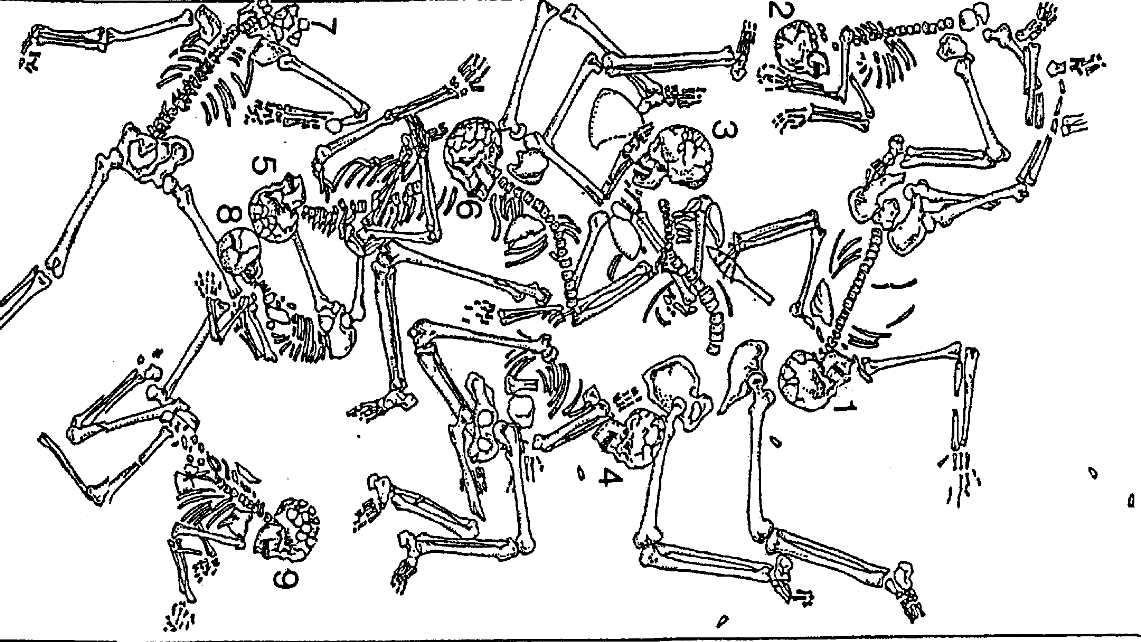
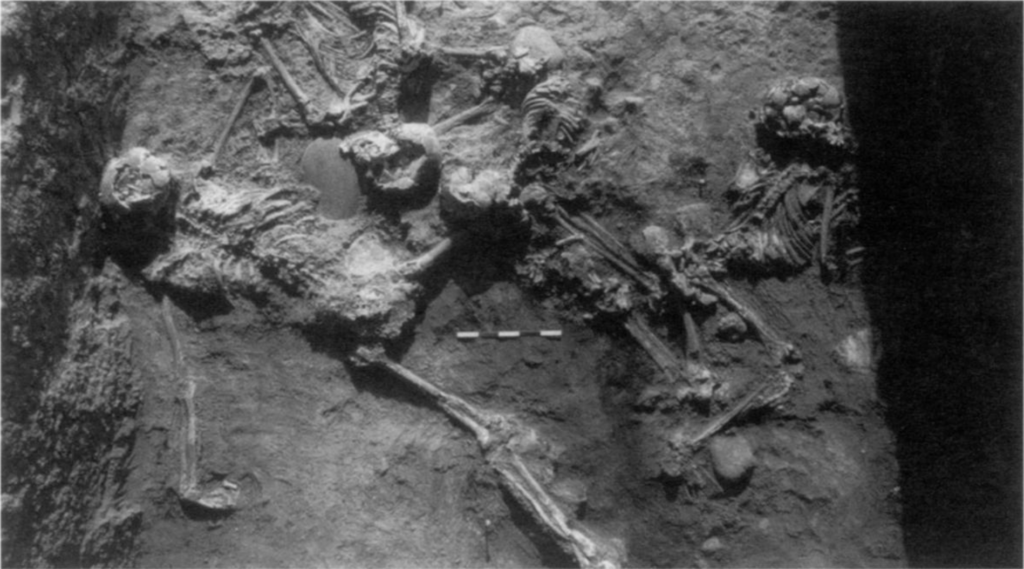
In the summer of 612 B.C., the ancient city of Nineveh fell to a coalition of Babylonians, Medes, and others. At the site of the Halzi Gate, located at the southeastern quarter of the ancient city, the late Dr. David Stronach from UC Berkeley directed excavations between 1987 and 1990 that uncovered one of the most dramatic scenes of ancient urban warfare ever documented. The entrance passage of the outer gate had been deliberately narrowed with mud-brick blocks from an original width of seven meters down to just two meters a defensive measure so constricting that only two people could work in the space at any one time during excavation. As archaeologists dug through the narrow passage, they reached an ashy destruction level above the cobbled pavement. The lens immediately above the pavement contained inscribed burnt bricks and sections of burnt wooden beams, and several of the skeletons showed signs of being burnt and harmed by falling debris, leading to their traumatic death. The density of skeletal material increased toward the interior of the gate, with skeletons lying where they had fallen, some on top of others.
In total, the excavation uncovered at least thirteen individuals designated skeletons A and 1 through 12 as well as the remains of a horse. The skeletal material was primarily excavated in 1990 by Marianne Marek, with osteological analyses prepared by Dr. M. Domurad and subsequently by Dr. Ethne Barnes. The detailed osteological examinations reveal individuals ranging from a ten-month-old infant to a seasoned warrior of approximately 35 to 40 years of age. Skeleton 1 is an adult male, 30 to 35 years old and 174 cm tall, who was found sprawled face downward with six broken ribs, a damaged right arm, and broken fingers; the habitual kneeling stress in his right elbow and the ball of his left foot indicate that he was an archer. Skeleton 2 is a pre-adolescent male, only 12 to 13 years of age and small for his size, with knife wounds above the eye and a fractured skull. Skeleton 3, an adult male 22 to 24 years old and 180 cm tall, had a fragmentary socketed iron spear beneath him and a bronze trilobate arrowhead next to his femur; lumbar lesions were attributed to brucellosis, a bacterial infection derived from goat milk products. Skeleton 4 was a pre-adolescent 11 to 12 years old, tall for his age, with a copper or bronze earring near the left ear and a bronze trilobate arrow embedded in his left fibula; a total of six arrowheads were found in the vicinity of this single individual. Skeleton 5, an adult male 35 to 40 years old and 172 cm tall, was possibly the oldest individual at the gate, with arthritis, periodontal disease, stab wounds in the back and through the lower right ribcage, and both legs fractured as well as numerous old, healed injuries indicating that he was a seasoned warrior. Skeleton 6, an adolescent male 17 to 18 years old, carried beneath his body a fine translucent pale-blue chalcedony conoid stamp seal with an attached bronze elbow fibula; a silver earring in the form of an inverted crescent suspended below a disc lay beneath the left wrist. Skeleton 7, an adult male 35 years old and 168 cm tall, was found face down on the pavement with cut marks on the left side of the skull, stress patterns indicating he too was an archer, and several old, healed wounds. Skeletons 8 through 11 represent a cluster of younger people found toward the rear of the entrance passage: a child 7 to 8 years old whose back appears to have been broken, with a silver earring near the right ear; an 11 to 12-year-old whose arms were burnt by falling debris; an infant of just ten months; and a child of three years the two youngest to die in the Halzi Gate conflagration. Skeleton 12, an adult male 27 to 30 years old and 166 cm tall, had cuts in the skull and a penetrating wound through the lower right abdomen caused by a blunt weapon; stress injuries of the right shoulder and hand suggest military duty.
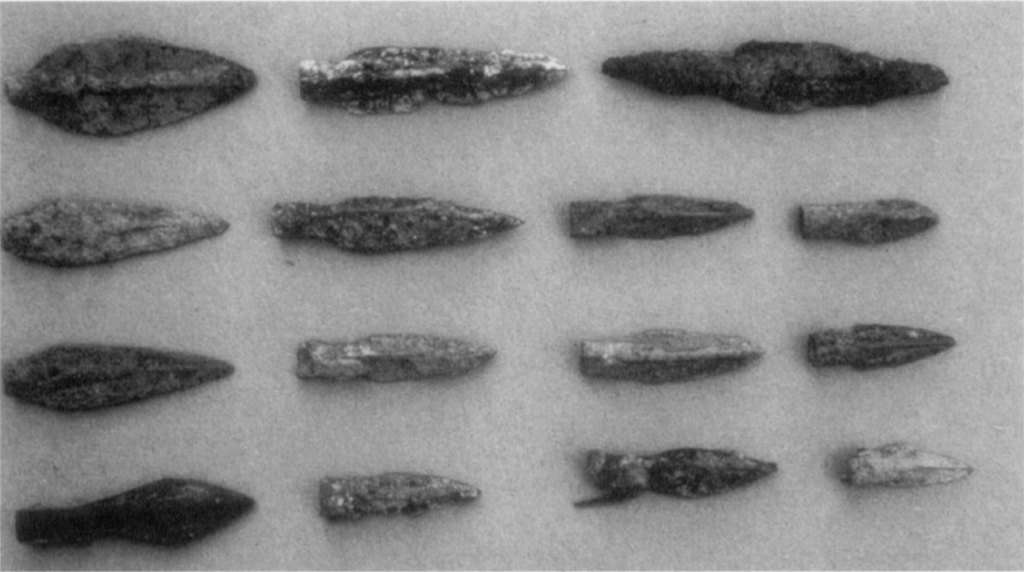
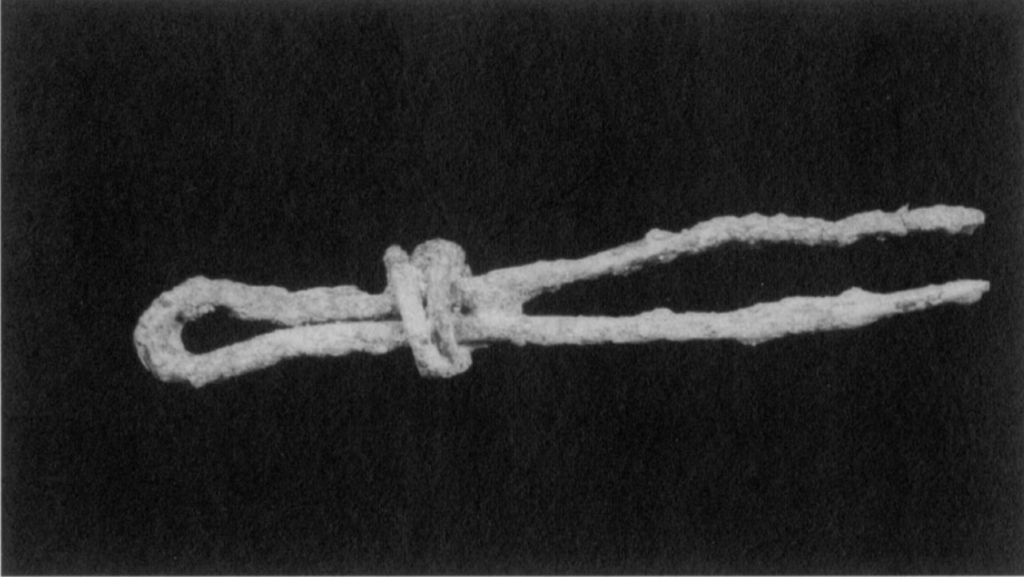
The weaponry scattered among the dead included twenty bronze arrowheads (bifacial, transitional-trilobate, and trilobate types), a lancehead, and iron spears. Personal possessions recovered from the gate area were equally telling: a composite necklace containing a white steatite scarab dated to the Egyptian twenty-sixth dynasty (664–525 B.C.), a cowrie shell modified for threading, twenty carnelian and four lapis lazuli beads, bronze tweezers, bronze fibulae, silver and copper earrings, a bronze bangle, bone tubes, and multiple stamp seals. The excavator concluded that "socially privileged individuals were amongst the dead." Among the seals, a duck-shaped green chalcedony stamp seal from the outer entrance passage bears the design of a stylized moon standard, reflecting, in the excavator's own assessment, "the importance of the god Sin of Harran at Nineveh." This detail is significant: the cult of Sin at Harran was closely associated with the Aramean population of the region, and Harran itself was a major center of Aramean culture and religion. The fine pale-blue chalcedony seal found beneath skeleton 6 was engraved with both Babylonian and Assyrian deities, the Mushhushshu dragon of Marduk and Nabu on its base, and the moon-god Sin on its side, illustrating the religious syncretism that characterized the cosmopolitan population of late Assyrian Nineveh.
Notably, the original excavation report records that "tentative plans to record DNA data from the skeletons had to be abandoned due to their poor preservation and contamination risk." It was only years later, through advances in ancient DNA extraction technology, that Dr. Michel Shamoon-Pour and colleagues at David Reich's Lab at Harvard Medical School were able to obtain viable genetic material from seven of the individuals. Dr. Arya Shehouse served as the main person working on the genetic analysis. According to Dr. Shamoon-Pour, who presented the genetic findings at a conference, these individuals died at the moment that the city of Nineveh was attacked at the site of the Halzi Gate.
Seven Distinct Mitochondrial DNA (mtDNA) Lineages: Extreme Genetic Diversity
From the skeletal remains, genetic results were obtained for seven individuals. Each of the seven belonged to a distinct mitochondrial DNA (mtDNA) lineage, representing maternal ancestry. None of the seven shared a haplogroup with any other. As Dr. Shamoon-Pour noted, this extreme diversity should not be surprising given that Nineveh was a cosmopolitan city with people of many different backgrounds. Most of the identified haplogroups have been reported from multiple populations of the Middle East, and many people today belong to these lineages. However, a couple of these haplogroups, especially X2p, are extremely rare, with perhaps only a dozen or two dozen contemporary individuals reported to belong to this group.
Y-Chromosome Paternal Lineages: R1b, T1a, and a Levantine Outlier
Y-chromosome results, representing paternal lineages, were obtained for three male individuals among the seven. Again, three different individuals yielded three different lineages. One individual belongs to a subclade of R1b, which is very common in most parts of Europe but also, as Dr. Shamoon-Pour's own published research has shown, found in somewhere between 45 to 50 percent of contemporary Assyrians. The second individual belongs to T1a, a haplogroup well known to be either of Mesopotamian origin or at least having a deep history in Mesopotamia, though it could also be from the Levant or Anatolia. The third individual, referred to as a "Levant outlier", clusters more closely with ancient individuals from Israel, Palestine, and Jordan, suggesting that this person had an ancestry that came from the Levant rather than from Mesopotamia, in contrast with the other six individuals who appear more likely to have been from Mesopotamia in origin.
No Kinship or Relatedness Among the Seven Nineveh Individuals
Testing for relatedness and kinship between the seven individuals produced a significant finding: there is no indication of any relatedness between them up to the fourth degree. This means there are no parent-child relationships, no siblings, no cousins, and not even second or third cousins among the group. This is particularly notable because four of the seven individuals were children, while the adults accompanying them at the site appear to have been guards or military men. The children were apparently caught up in the chaos when the city was being attacked; the defenders, including these individuals, were almost certainly trying to flee, but the invaders did not allow them to leave. They were caught in the middle as the gate was attacked and collapsed, burning down and killing those at the site.
Population Modeling: Iron Age Armenia, Hasanlu, and Early Bronze Age Jordan
Preliminary population modeling, comparing the ancient Ninevites with other ancient individuals from the Near East, yielded a best-fit model in which these individuals share 75 to 80 percent of their ancestry with people of Iron Age Armenia or the Late Bronze Age site of Hasanlu (in the Urmia region of Iran), with the remaining approximately 25 percent of their genetics sharing ancestry with individuals discovered in Early Bronze Age Jordan. Dr. Shamoon-Pour emphasized that these are preliminary results and that the modeling is ongoing.
Why the Seven Halzi Gate Samples Are More Likely Aramean Than Assyrian
Given the extensive historical evidence presented in Chapter 1, the possibility that some or all of the seven individuals from the Halzi Gate were of Aramean origin or descent is not merely plausible, it is, on the balance of the available evidence, arguably more likely than the assumption that they were ethnic Assyrians. Several converging lines of evidence support this conclusion.
The most immediate and striking piece of evidence is the genetic diversity itself. Seven individuals, seven completely distinct maternal lineages, three males with three completely distinct paternal lineages, and zero relatedness among any of them up to the fourth degree. This is not the genetic profile one would expect from a homogeneous population. Dr. Shamoon-Pour himself pointed to a separate study of 86 modern Assyrian samples from northern Iraq, which found that Assyrians showed more evidence of being endogamous and conservative, having only 10 Y-haplogroups compared to 11 to 16 among other groups tested. Modern Assyrians, in other words, display relatively less genetic diversity than surrounding populations, a pattern consistent with centuries of communal endogamy shaped by cultural, religious, and linguistic traditions that limit intermarriage. The seven Halzi Gate individuals, by contrast, display extreme diversity. This contrast is significant: if the seven individuals at the gate were drawn from a predominantly ethnic Assyrian population, one might expect to see at least some shared lineages or some degree of relatedness, as ethnic Assyrians have historically tended toward in-group marriage. The fact that there is no overlap at all, not even distant cousinship, suggests that these individuals were drawn from the broader, more diverse, cosmopolitan population of late 7th-century Nineveh, not from a single endogamous ethnic community.
Second, the historical and demographic evidence strongly favours a non-Assyrian majority in late Nineveh. According to H.W.F. Saggs, the urban centers of Assyria had become so cosmopolitan through the empire's deportation policy that people of native Assyrian descent may have formed only a minority within them. The Prosopography of the Neo-Assyrian Empire records 3,117 individuals with Aramaic names across the empire, of which 189 can be specifically located in Nineveh, and this figure only captures those who bore identifiably Aramaic names. Many Arameans adopted non-Aramaic names, meaning the true Aramean population of Nineveh was likely significantly higher. Their recorded professions spanned every sector of urban life: agriculture, craft production, commerce, the military, administration, palace staff, priests, and scholars. If ethnic Assyrians were possibly a minority in their own capital, then a random sample of seven unrelated individuals from Nineveh at the time of its fall would statistically be more likely to contain non-Assyrians, including Arameans, than to consist entirely of ethnic Assyrians.
Third, the Arameans had a documented presence in and around Nineveh spanning at least five centuries before the city's fall. As early as the 1080s B.C., Aramean forces advancing from Tur Abdin captured Nineveh itself, as recorded in the Middle Assyrian chronicle. From that point onward, the Aramean demographic presence in Assyria's heartland only grew, through continued migration, through the establishment of Aramean tribal states in the immediate vicinity of the Assyrian heartland (Bet-Zammani with its capital at Amida, the Temanites at Nisibis and Gidara, Bet-Yahiri in the Izalla region, Assa to the west), and through the Assyrian empire's own systematic policy of mass deportation, which over three centuries displaced approximately 4.5 million people, many of them Arameans, and resettled them in cities such as Ashur, Nimrud, Nineveh, and Dur-Sarrukin. Aramaic replaced Akkadian as the daily language of the empire. The Aramaization of Assyria was so thorough that the empire has been described by scholars as an "Aramean–Assyrian empire," and the Arameans' integration into every level of society, from agricultural laborers to palace scribes to the queen mother Naqia herself, means that any random sample of individuals from late 7th-century Nineveh would carry a very substantial probability of including Arameans.
Fourth, the presence of a "Levant outlier" among the seven, an individual whose genetics cluster more closely with ancient individuals from Israel, Palestine, and Jordan, is entirely consistent with the known patterns of Assyrian deportation. Assyrian kings explicitly recorded deporting people from the Levant into the Assyrian heartland. This individual's genetic profile is far more consistent with someone descended from a deported Levantine population than with an ethnic Assyrian background. Aramean tribal states such as Aram-Damascus, Hamath, and Bit-Agusi were major Levantine polities whose populations were among those deported by Assyrian kings. The remaining six individuals, who cluster with Mesopotamian populations, are consistent with people whose families had been rooted in Upper Mesopotamia for generations, a description that fits the Arameans, who had been settled in the Tigris-Khabur-Tur Abdin zone since at least the 13th century B.C., just as well as or better than it fits ethnic Assyrians.
Fifth, the population modeling showing 75–80% shared ancestry with Iron Age Armenia and Late Bronze Age Hasanlu, with approximately 25% Early Bronze Age Jordan ancestry, does not point specifically to Assyrian identity. The Arameans were indigenous to Upper Mesopotamia and the areas around Tur Abdin, the very region that borders Armenia and shares deep population history with the Iranian plateau via sites like Hasanlu. By the Iron Age, as Dr. Shamoon-Pour noted during the discussion period, the genetics of populations across the region had become very similar through millennia of gene flow, mass movements, and forced intermingling. He explained that populations seem to start looking more and more similar by the Bronze Age, and by the Iron Age even more so, and that the changes that happened in the past 2,500 or 3,000 years are only a fraction of the change between 8,000 years ago and 3,000 years ago. The genetic distinction between Arameans, Assyrians, Armenians, and other groups native to northern Mesopotamia would therefore have been minimal to non-existent at the genomic level by 612 B.C. The modeling results are equally consistent with Aramean ancestry as with Assyrian ancestry.
Sixth, the context of the Halzi Gate itself deserves consideration. These individuals died in the chaos of a military assault on one of the city gates. Four of the seven were children, and the adults appear to have been guards or military men. They were not found in a royal palace, a temple of Ashur, or a distinctly Assyrian institutional context, they were found at a city gate, the kind of location where all segments of the urban population, including Aramean residents, craftsmen, traders, soldiers, and their families, would have been present during a siege. The full archaeological record from the Halzi Gate excavation (Pickworth 2005) reinforces this point dramatically: the thirteen individuals recovered include not only adult warriors with combat injuries and stress patterns consistent with archery, but also a ten-month-old infant, a three-year-old child, and several pre-adolescents, clear evidence that civilian families, not merely a military garrison, were caught in the conflagration at the gate. The entrance passage had been narrowed from seven meters to just two meters as a desperate defensive measure, trapping defenders and civilians alike in a lethal bottleneck as the gate was stormed and collapsed in flame. The Assyrian army and its garrison forces are well documented as having included large numbers of Arameans on ration lists alongside Assyrians and other groups. It would be entirely unremarkable for Aramean soldiers and their dependents to be among the defenders at a city gate.
Seventh, the material culture recovered from the Halzi Gate itself carries Aramean cultural resonances. Among the personal possessions found with the dead, a duck-shaped green chalcedony stamp seal bears the stylized moon standard of Sin of Harran, a cult center of enormous importance to the Aramean population of Upper Mesopotamia. The excavator herself noted that the seal reflects "the importance of the god Sin of Harran at Nineveh." Harran was one of the foremost Aramean religious and cultural centers, and the prominence of its lunar cult in the personal effects of a Halzi Gate individual is at least consistent with, and arguably suggestive of, an Aramean cultural affiliation among those who died at the gate. The presence of objects combining Babylonian and Aramean religious motifs (the Mushhushshu dragon of Marduk and Nabu alongside the moon-god Sin) on a single seal beneath skeleton 6 further underscores the deeply syncretic, cosmopolitan character of these individuals, precisely the kind of cultural mixing that the centuries-long Aramaization of Nineveh would predict.
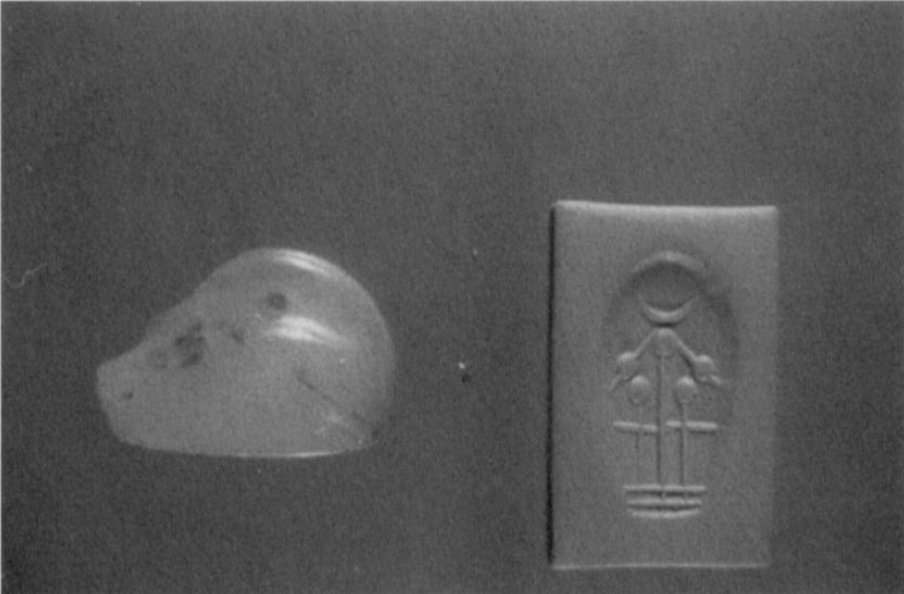
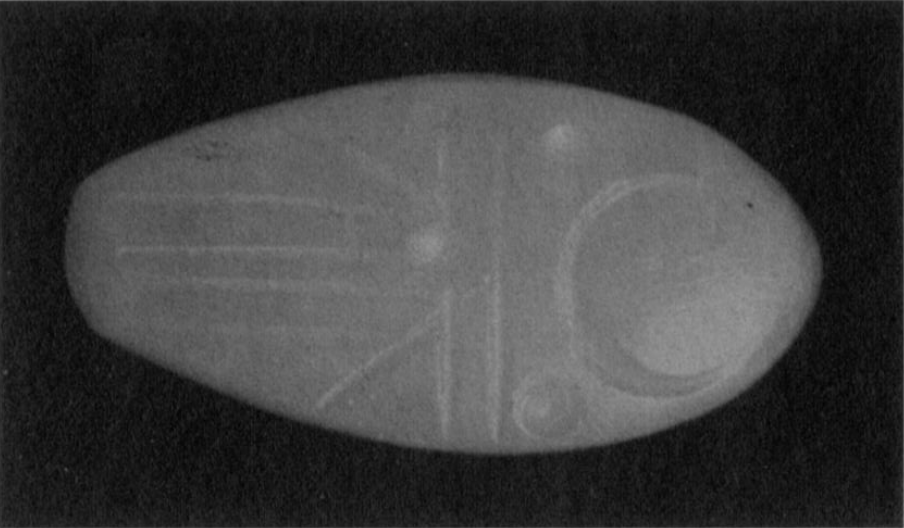
The importance of Sîn of Harran as an Aramean deity in this region is supported by the 2018 discovery at Başbük near Siverek in southeastern Turkey. Excavations revealed a rock-cut sanctuary with a 3.96-meter wall panel depicting eight deities, all labeled in Aramaic rather than Akkadian cuneiform, and notably excluding the Assyrian god Ashur. The panel follows an Aramean religious order, with Hadad as the supreme deity, a role that would have belonged to Ashur in an Assyrian context. All divine names are written in their Aramaic forms, with no Assyrian spellings. The panel has therefore been identified as Aramean, and the absence of Assyrian elements such as the god Ashur and Akkadian labeling makes an Assyrian attribution highly unlikely. Among the procession appears Sîn, the Moon God of Harran, identified by a crescent and full moon crown. This is significant for the Halzi Gate finds, as the moon standard of Sîn appearing on a personal seal among the dead is consistent with an Aramean cultural context.
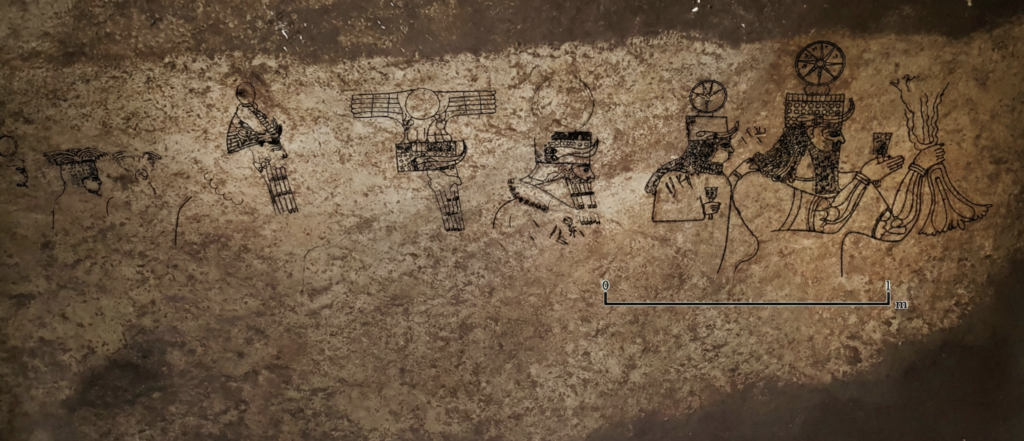
Taken together, these lines of evidence, the extreme genetic diversity inconsistent with Assyrian endogamy, the demographic reality of Assyrians being possibly a minority in their own cities, the five centuries of Aramean presence in the Nineveh area, the 4.5 million deportees reshaping the empire's population, the thorough Aramaization of Assyrian society, the Levantine outlier consistent with Aramean deportation patterns, the gate context reflecting a civilian population including infants and children alongside soldiers, and the material culture including a seal bearing the moon standard of Sin of Harran, build a cumulative case that the seven Halzi Gate individuals were more likely drawn from the diverse, heavily Aramaized population of Nineveh than from a purely ethnic Assyrian community.
Ancient DNA, Ethnic Identity, and Why Genetics Cannot Determine Who You Are
Dr. Shamoon-Pour himself offered important and repeated caveats about the relationship between genetics and identity throughout his presentation. He emphasized that paleogenomics, while very exciting, should be thought of as something that runs in parallel with linguistics, archaeology, and other disciplines, it provides data points about population interactions and movements, but it is not a tool for determining ethnic identity. He stated plainly: "It's easy to confuse the genetic results with identity, and I really hope that everyone remembers that we shouldn't read too much into these results. After all, first of all, we don't know exactly, in this case or in any case, when we are looking into the remains of an ancient individual, we can hardly be sure what they identified as." He continued: "More importantly, the genetics changes, like I said, for so many reasons, our identities, our ethnic, our linguistic, our religious identities, are really quite separate from our genomics, and I personally think that there is no relation between that." He concluded this point with particular directness: "We should never draw on genetic results to infer things about one's identity."
Dr. Shamoon-Pour also addressed the commercial ancestry testing industry, cautioning that while such tests are a matter of curiosity and perfectly fine to pursue, they are ultimately a business selling a product and thereby commercializing the concept of genomic identity. He noted that he had not done such testing himself, and urged that whatever the results, they tell you about your biological history, which could be quite separate from your otherwise history. He emphasized that genetic ancestry goes back tens of thousands of years, while no form of identity, linguistic, religious, ethnic, goes back more than four or five thousand years at most, and rarely even that far. Therefore, everyone who comes from northern Mesopotamia is likely to share a great deal of genetics that dates from before they were distinguished as different ethnic groups, including Assyrians versus other people native to northern Mesopotamia. He ended with a reminder that everyone has the right to self-identification: "You are who you are in terms of your identity. Don't ever let anyone tell you otherwise. I'm not lecturing to you, I'm just saying that from a genetic perspective, I'm confirming the well-known fact that we should do so, and it's a complete separation of genetics and other forms of identity."
These observations are directly relevant to the question of whether the Nineveh individuals were Aramean. Precisely because the genetics of northern Mesopotamian populations had become so similar by the Iron Age, genetic data alone cannot distinguish an Aramean from an Assyrian or from any other group native to the region. What the genetics can tell us is that the seven individuals are consistent with a northern Mesopotamian population, and the historical evidence demonstrates overwhelmingly that Arameans were a major, and possibly the largest, component of the population of Nineveh by the time of the city's fall. The genetic data does not contradict Aramean identity; the historical data actively supports it.
Epigenetics: Trauma, Genocide, and Generational Inheritance
During the discussion period, a question was raised about epigenetics, the concept of marks left on one's genetics that can be passed for a couple of generations. Dr. Shamoon-Pour explained that epigenetics is different from genetics in the sense that while genetics is inherited from parents in a stable manner across all generations, epigenetics does not carry through in the same way. It is now known for certain that epigenetic marks can be passed on for two generations, and there are some studies indicating that they may persist for three generations, but it is extremely doubtful that they could pass beyond that. In other words, epigenetic marks, which can be impacted by extreme life events such as war, genocide, or famine, affect one's children and probably their grandchildren, but current evidence does not support transmission beyond that point. Dr. Shamoon-Pour mentioned that there have been studies of Holocaust victims and that he had discussed the possibility of studying epigenetics of Syriac Christians to see if any indications of changes related to the Sayfo (Aramean genocide) could be found.
Assyrian Deportations and Their Impact on the Genetic Makeup of Nineveh
During the question period, the significance of the Assyrian deportation process for genetic makeup was raised. Dr. Shamoon-Pour agreed that the scale of some of these mass movements was very significant, especially in comparison with the populations at the time. He noted that during certain periods, specific numbers of individuals were recorded, for instance, 7,500 individuals moved, an entire city relocated a few hundred kilometers. Sometimes this represented one, two, or three percent of the total population. Such movements could have had major impact on the formation of population genetics, and this, as Dr. Shamoon-Pour suggested, might be one of the mechanisms by which many of these populations during the Bronze Age and after became increasingly similar to each other, through forced intermingling of populations over generations.
This observation applies directly to the Aramean presence in Nineveh. The Assyrian deportation policy explicitly targeted Aramean populations. Sennacherib claims to have deported Chaldaeans, Arameans, and others. These deportees were resettled in the principal Assyrian cities including Nineveh, where they integrated into the existing population over generations. After approximately 200 years, as was noted in the discussion, the assimilation process becomes a reality, but the genetic and demographic imprint of the deported Aramean population would have persisted and indeed become part of the fabric of the city's population.
What the Halzi Gate Ancient DNA Means for Modern G25 Genetic Distance Comparisons
A final consideration concerns the implications for modern individuals who use tools such as G25 (a genetic distance calculator widely used in population genetics) to compare their own DNA with ancient samples. When a modern person today finds that they match closely with one or more of the seven Halzi Gate individuals, it is essential to understand what that match actually represents. These seven individuals are not a single homogeneous "Assyrian" reference population. They are seven completely unrelated people, each with a distinct maternal lineage, each drawn from what the historical record tells us was one of the most cosmopolitan and ethnically diverse cities in the ancient world, a city where ethnic Assyrians may have been a minority, where Arameans were documented at every level of society, and where deportees from across the Near East had been resettled for centuries.
A close G25 match with a Halzi Gate individual therefore does not constitute evidence of "Assyrian" ancestry any more than it constitutes evidence of Aramean, Hurrian, or Levantine ancestry. The seven samples represent seven different lineages from the burning gates of Assyria's greatest city, a city that, by the time of its fall, was the product of centuries of Aramaization, mass deportation, and demographic transformation. The individuals found at the gate were, on the balance of the historical evidence, most likely of non-Assyrian descent: they represent the diverse, mixed, heavily Aramean-influenced population that late Assyrian Nineveh had become. Matching closely with them on a genetic distance calculator is matching with the cosmopolitan remnants of a multiethnic empire, not with a single ethnic lineage. As Dr. Shamoon-Pour emphasized, genetics and identity are separate domains, and the biological history reflected in a genetic test goes back tens of thousands of years, far beyond any ethnic or linguistic label that exists today or existed in 612 B.C.
Keywords: Arameans in Mesopotamia, ancient DNA Nineveh, Halzi Gate 612 BC, Aramaization of Assyria, Bet-Zammani, Tur Abdin Arameans, Temanites Nisibis, Aramaic language Assyrian Empire, Neo-Assyrian deportations, ancient Nineveh genetics, Aramean kingdoms Upper Mesopotamia
Citations
Bibliography
- Lipinski, Edward. The Aramaeans: Their Ancient History, Culture, Religion. Orientalia Lovaniensia Analecta 100. Leuven: Peeters Publishers, 2000.
- Niehr, Herbert (ed.). The Aramaeans in Ancient Syria. Handbook of Oriental Studies, Section 1, Volume 106. Leiden: Brill, 2014.
- Chapter by Martti Nissinen: "Outlook: Aramaeans Outside of Syria — 1. Assyria," pp. 273–296.
- Chapter by Martti Nissinen: "Outlook: Aramaeans Outside of Syria — 1. Assyria," pp. 273–296.
- Shamoon-Pour, M. (n.d.). Part 7: Nineveh academic chair - 2nd International Assyrian congress - University of Salamanca/Spain [Video]. YouTube. https://www.youtube.com/watch?v=87m9LG-cTp8
- Pickworth, Diana. "Excavations at Nineveh: The Halzi Gate." Iraq 67, no. 1 (2005): 295–316.
- Saggs, H.W.F. The Might That Was Assyria. London: Sidgwick & Jackson, 1984.
- Breasted, James Henry. Ancient Times. Boston: Ginn and Company, 1916.
- Joseph, John. The Modern Assyrians of the Middle East: Encounters with Western Christian Missions, Archaeologists, and Colonial Power. Leiden: Brill, 2016.
- Tadmor, Hayim. "The Aramaization of Assyria: Aspects of Western Impact." Mesopotamien und seine Nachbarn, vol. 2, 1982, pp. 449–470.
- Ben Zvi, Ehud. Social Memory Among the Literati of Yehud. Berlin: De Gruyter, 2019.
- Dalley, Stephanie. The Legacy of Mesopotamia. Oxford: Oxford University Press, 2005.
- Aruz, Joan, and Michael Seymour. Assyria to Iberia: Art and Culture in the Iron Age. New York: Metropolitan Museum of Art, 2016.
- Barsoum, Afrem. The History of Tur Abdin. Piscataway: Gorgias Press, 2008.
- Goodspeed, George Stephen. A History of the Ancient World. New York: C. Scribner's Sons, 1912.
- Hecker, Karl. Referenced in Lipinski 2000a regarding siege descriptions, p. 63.
Önal, Mehmet, Celal Uludağ, Yusuf Koyuncu, and Selim Ferruh Adalı. "An Assyrianised Rock Wall Panel with Figures at Başbük in South-Eastern Turkey." Antiquity 96, no. 387 (2022): 575–591. doi:10.15184/aqy.2022.48.